English
In today's digital era, the demand for high-speed, high-bandwidth, and low-latency network solutions in data centers is growing at an unprecedented pace. In 400G single-mode fiber applications over transmission distances exceeding 100 meters, the 400G DR4 and 400G FR4 optical modules have emerged as two mainstream and critical technological solutions.
This blog will provide an in-depth exploration of the technical specifications, core differences, and typical connection methods of 400G DR4 and 400G FR4 optical modules. By comprehensively analyzing the working principles and application scenarios of these two types of optical modules, we aim to help readers better understand their roles and value within modern data center interconnection architectures.
1. What Is a 400G DR4 Optical Module?
The 400G DR4 optical module is a photonic transceiver that achieves 400G data transmission based on Parallel Single-Mode (PSM) technology. It employs four independent 100G PAM4 signal channels, each operating at the same 1310nm wavelength. On the transmit side, an integrated laser array drives four optical signals, which are then transmitted via an MPO-12 APC multi-fiber connector.
This module supports two typical transmission distances: 500 meters and 2 kilometers. AICPLIGHT offers both IEEE-compliant 400GBASE-DR4 (500m) and an extended-reach version, 400GBASE-XDR4 (2km).
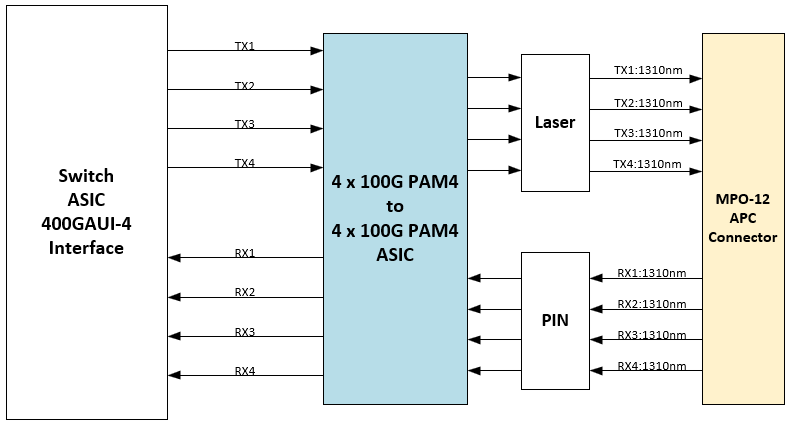
400G OSFP DR4 Schematic Diagram
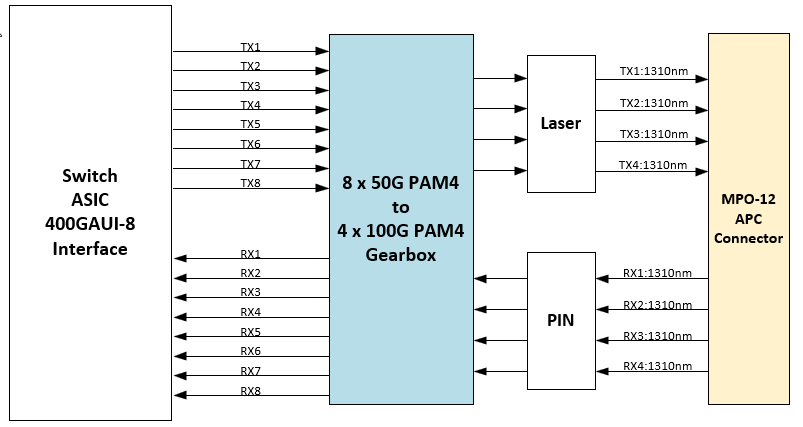
400G QSFP-DD DR4 Schematic Diagram
2. What Is a 400G FR4 Optical Module?
The 400G FR4 optical module utilizes Wavelength Division Multiplexing (WDM) technology. Its core mechanism involves combining four distinct wavelengths—1271nm, 1291nm, 1311nm, and 1331nm—into a single composite optical signal through an optical multiplexer (MUX). At the receiving end, a demultiplexer (DEMUX) separates the combined signal back into its original four channels. Unlike the DR4, the FR4 uses a duplex LC UPC interface, requiring only two single-mode fibers (one for transmit and one for receive), significantly conserving fiber resources.
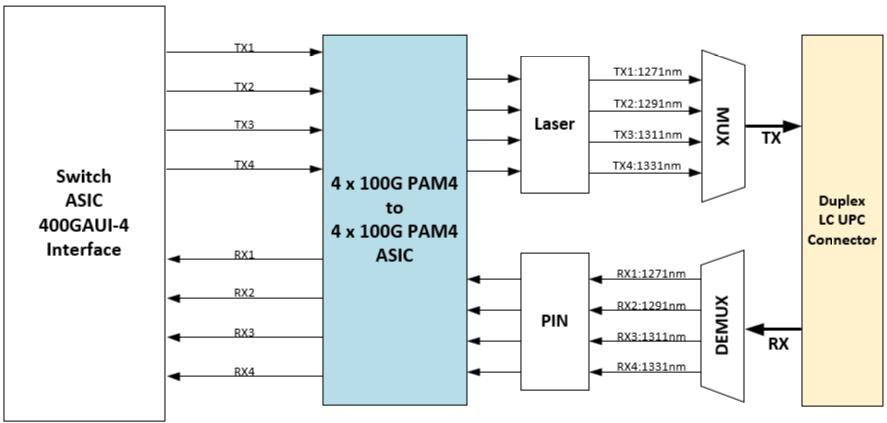
400G OSFP FR4 Schematic Diagram
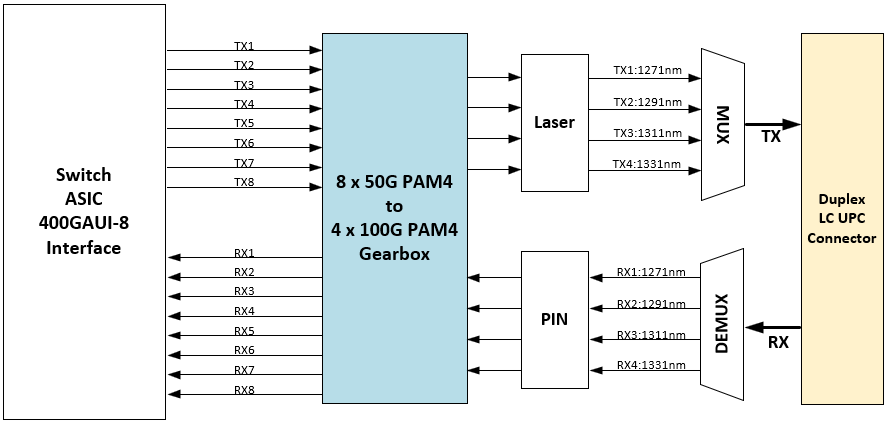
400G QSFP-DD FR4 Schematic Diagram
3. 400G DR4/XDR4 vs 400G FR4
| 参数 | 400G DR4/XDR4 | 400G FR4 |
|---|---|---|
| 工作原理 | 并行光传输(4×100G) | 波分复用(WDM) |
| 所需光纤数量 | 8根光纤 | 2根光纤 |
| 接口类型 | MPO-12 APC | 双工LC UPC |
| 通道波长 | 4个通道均使用1310nm | 4个波长:1271/1291/1311/1331nm |
| 典型距离 | DR4: 500m XDR4: 2km | 2km |
| 应用场景 | 400G点对点直连 4×100G分支连接 | 400G点对点直连 |
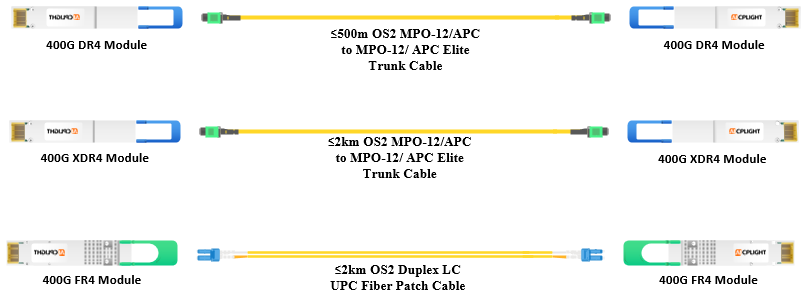
Both 400G DR4/XDR4 and 400G FR4 support 400G-to-400G direct connections. However, due to differing optical interfaces, they require different types of fiber patch cables:
The 400G DR4 or XDR4 uses an MPO-12 fiber cable.
The 400G FR4 uses a duplex LC fiber cable.
Under the same transmission distance, MPO-12 patch cables are generally more expensive than duplex LC cables.
 ### 4.2 400G Breakout Connection Solution
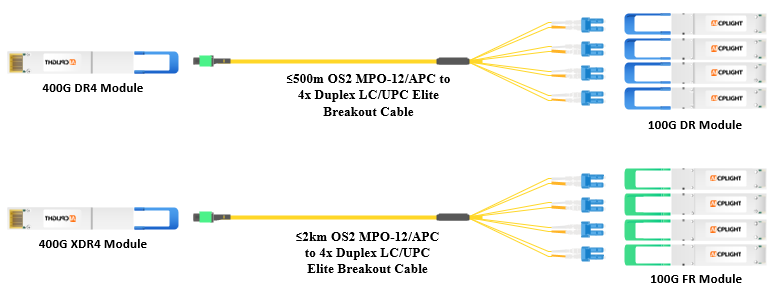
A key advantage of the 400G DR4/XDR4 is its interoperability with 100G single-wavelength optical modules. This enables compatibility with equipment requiring high-density connectivity, allowing a 1-to-4 breakout configuration—where one 400G port can be split into four independent 100G links.
In summary, the 400G DR4/XDR4 and 400G FR4 optical modules each possess unique characteristics, representing two major technological approaches: parallel transmission and wavelength division multiplexing, respectively. These modules have become essential building blocks for constructing efficient, scalable, and high-performance interconnect architectures in today's hyperscale data centers.